


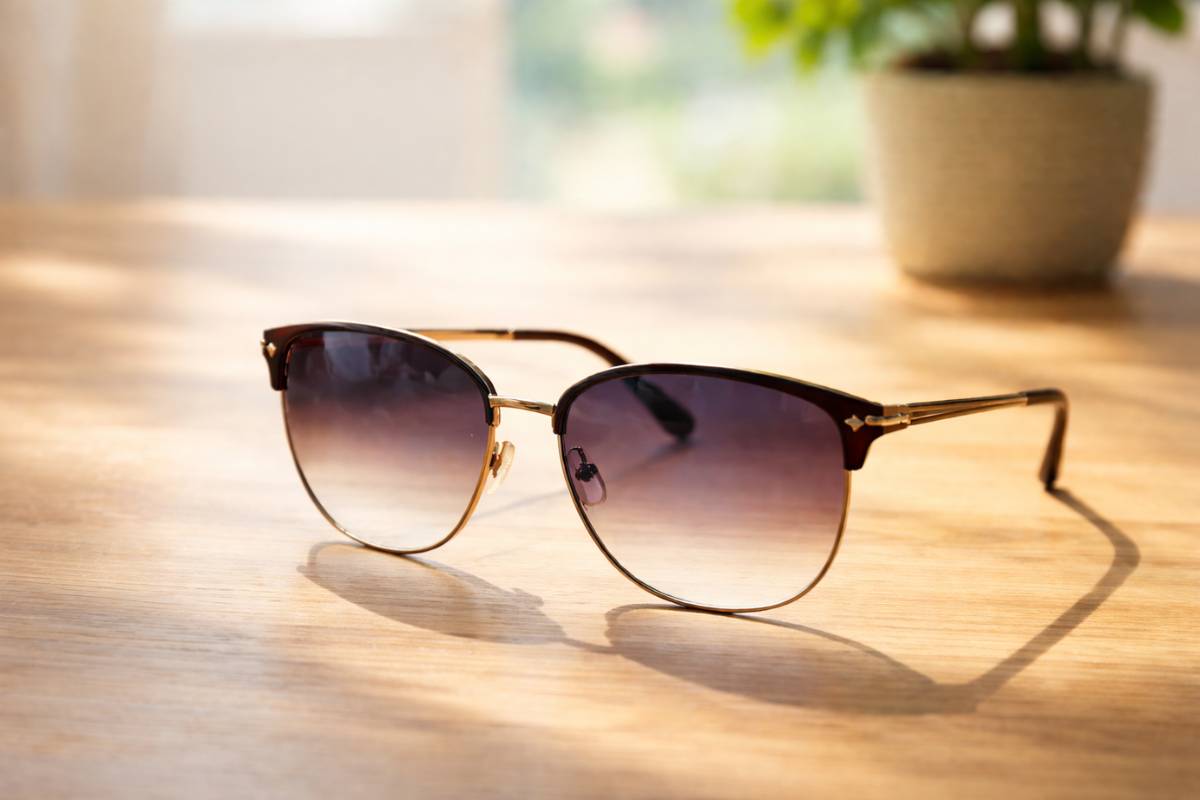
Are gradient lenses just an aesthetic choice?
When it comes to gradient lenses, the first association is often related to aesthetics: an elegant detail, a choice of style, a distinctive element of sunglasses. In reality, stopping at this interpretation is reductive. Gradient lenses are born with a strong aesthetic component, but they also integrate a Practical function which can improve the viewing experience in different everyday situations. Their structure, characterized by a darker upper part and a lighter lower part, is not accidental, but responds to a concrete need: manage light in different directions of the gaze in a more balanced way. This makes them particularly versatile, especially for those who use sunglasses in dynamic contexts, between outdoor environments and moments of close vision. Understanding their role means going beyond the aesthetic aspect and evaluating their real contribution to visual comfort.
How gradient lenses work
Gradient lenses are distinguished by a gradual distribution of color intensity, which varies from the top to the bottom of the lens. The darker area, positioned at the top, has the task of shielding direct light from above, such as that of the sun, while the lower part, lighter, allows a sharper and less filtered view downwards. This type of setup is particularly useful in everyday tasks, because it naturally follows the Gaze behavior: When looking far away or towards the horizon, you use the top of the lens, while for close activities, such as reading or checking your phone, the bottom comes into play. This smooth transition avoids abrupt changes in brightness and makes your vision smoother. It is therefore not a simple aesthetic choice, but a solution designed to accompany the natural movement of the eyes.
A lens designed for everyday use
One of the main advantages of gradient lenses is their versatility. Unlike uniform lenses, which maintain the same level of darkening across the entire surface, gradient lenses allow you to better adapt to different situations without having to take off your glasses. This makes them particularly practical in urban contexts or during daily activities such as walking, driving or standing in semi-covered environments. The possibility of having a lighter lower part facilitates actions that require precision up close, avoiding the feeling of “darkness” typical of very dark lenses. At the same time, protection from bright light remains effective at the top. This combination makes them a balanced choice for those looking for a compromise between protection and practicality, without sacrificing aesthetics.
Gradient lenses while driving: a concrete example
A practical example of the usefulness of gradient lenses is the guide. In this situation, the gaze moves continuously between the road, which requires protection from bright light, and the dashboard, which must be easily readable. Completely dark lenses can make the interior details of the car less visible, forcing you to put more strain or take off your glasses. Gradient lenses, on the other hand, allow you to maintain a more balanced vision: the upper part protects against glare, while the lower one makes it easier to read information. This contributes to a more comfortable and continuous drive, especially on long journeys or in changing light conditions. It is precisely in situations like this that the functional value of shading emerges.
Visual comfort and light perception
Gradient lenses offer a good level of visual comfort, especially for those who spend a lot of time outdoors but it needs a more “flexible” vision. The smooth transition of color reduces the impact of light without creating a uniform darkening effect, which can be excessive in some cases. This allows the eyes to adapt more easily to different light conditions, improving the overall perception of the environment. However, it is important to emphasize that their contribution is mainly related to the Brightness management and not to a technical reduction of reflections or an improvement in contrast. Comfort therefore derives from the naturalness of vision and the possibility of using the glasses more continuously, without frequent interruptions.
Gradient lenses: limits and differences compared to other solutions
To really understand the role of gradient lenses, it’s also helpful to consider what they don’t do. Unlike other more technical solutions, they do not intervene on the reflections, do not change the perception of contrast and do not adapt automatically to the light. This means that in the presence of intense reflections, such as on water or wet asphalt, they do not offer the same level of performance as a polarized lens. Similarly, they are not designed to respond to changes in brightness dynamically. Their strength remains their versatility and ease of use, not advanced technical performance. This does not make them any less valid, but places them in a precise context: that of a functional lens for everyday use.
When to choose gradient lenses
Gradient lenses are particularly suitable for those looking for a balanced solution between aesthetics and functionality, especially in urban contexts or during daily activities. They are ideal for those who often enter and leave indoor environments, for those who drive frequently or for those who want a lens that allows you to carry out activities up close without taking off your glasses. They can also be a suitable choice for those who prefer a lighter and less “opaque” look than uniform lenses. Their effectiveness therefore depends on the context of use: they are not designed for extreme light conditions or for specific activities, but to accompany the vision in everyday life in a natural and continuous way.