

Contact lenses: from invention to the latest innovations
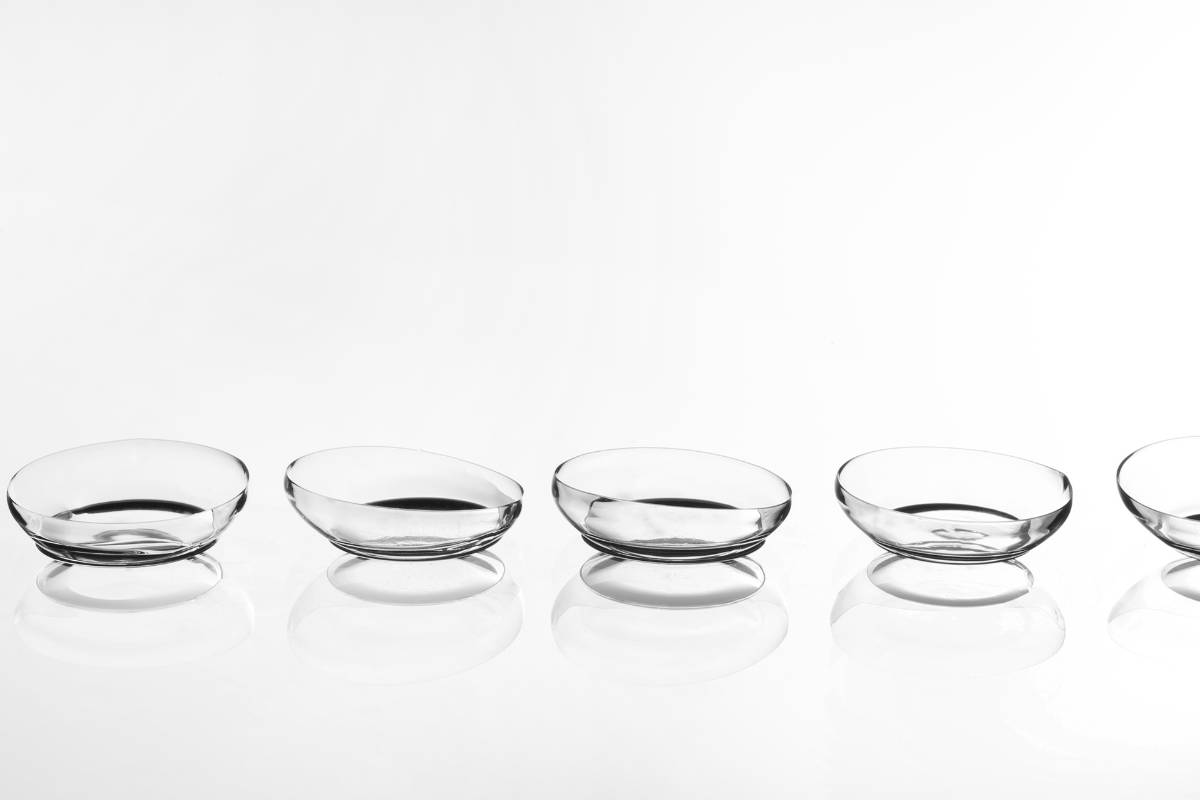
Contact lenses, over time, have made an incredible journey from those who invented contact lenses to sophisticated vision correction devices. These are thin, transparent optical devices designed to be placed directly on the surface of the eye. These devices offer vision correction for many eye problems, such as nearsightedness, farsightedness, astigmatism, and presbyopia.
Contact lenses can also be used for aesthetic purposes, to temporarily change the color of the eyes, or for therapeutic purposes.
Contact lenses: a fascinating story
The concept of contact lenses dates back to at least the seventeenth century. In 1632, the British naturalist and philosopher John Herschel proposed the idea of modifying the shape of the cornea to correct visual defects.
The practical making of contact lenses was not possible until much later.
The first contact lens
In 1888 the German physician Adolf Gaston Eugen Fick manufactured the first contact lens using glass and he made the first correction of myopic vision. These early lenses were uncomfortable and not suitable for prolonged use.
At the beginning of the twentieth century, interest in contact lenses increased until it led to the construction of the first corneal sclero shells by Gebruder Muller.
Subsequently, thanks to Zeiss in 1929 it was possible to have shells cut for keratoconus with an optical correction then extended to the correction of all ametropias.
Plastic contact lenses: the first real innovation
The real turning point for contact lenses occurred in the 1930s and 1940s with the development of plastic materials.
Czech chemist Otto Wichterle created the first soft contact lenses using hydrogel, a material that is more flexible and comfortable than glass.
HEMA lenses
In 1953, the Director of the Institute of Chemistry in Prague, Otto Wichterle , filed a patent for a material made of Flexible hydrophilic gel for the production of organic substitute products and contact lenses.
The following year, a copolymer of 2 hydroxymethylmethacrylate (HEMA) was produced and applied for the production of contact lenses.
Subsequently, after an initial slowdown, it was switched to industrial production by Bausch & Lomb (Soflens).
The HEMA lenses seemed the best and without problems, their immediate comfort and their daily wearability without apparent difficulties, gave ample satisfaction to the wearers.
Around 1980, however, intolerances and inflammatory and infectious complications due to contact lenses were observed. Many wearers were forced to partially use hydrogel lenses.
Gas permeable contact lenses
Research developed for gas-permeable lenses starting from those in CAB (cellulose acetobutyrate) to those in first-generation silicone up to those in silicone and acrylate copolymer and silicone and fluorine, which improved permeability so as to reduce corneal edema and other problems related to oxygen insufficiency.
Toric and multifocal lenses
In the years since, technological developments have continued to improve contact lenses. In 1971, rigid gas-permeable contact lenses were introduced, offering better breathability and comfort than Traditional rigid versions.
Later, toric lenses to correct astigmatism and multifocal lenses became available, further expanding the options for those who require specific vision corrections.
The latest invention regarding the material used in contact lenses is silicone hydrogel, which allows greater circulation of oxygen between the lenses and the cornea.
Reduced oxygen permeability can create problems such as dry eyes or red eye syndrome. Silicone hydrogel contact lenses, which make it possible to oxygenate the eye more, combat these types of problems.
Colored contact lenses, the fashion of the moment
Colored contact lenses have become a popular choice that has allowed people to temporarily change your eye color.
The future of contact lenses looks promising, with continuous research and development to further improve comfort, functionality and adaptability.
From simple experiments to an essential component in modern vision correction, contact lenses have truly gone through a fascinating historical and evolutionary journey.
The various types of contact lenses
Contact lenses are thin, transparent optical devices that are designed to be placed directly on the surface of the eye. These devices offer vision correction for a variety of eye problems, such as myopia, hyperopia, astigmatism and presbyopia.
Contact lenses can also be used for aesthetic purposes, to temporarily change eye color or for therapeutic purposes.
There are different types of contact lenses:
- Made of hard materials such as PMMA (polymethyl methacrylate) or rigid gas-permeable materials, these lenses retain their shape on the surface of the eye. They provide clear vision but require a period of adjustment.
- Made of flexible materials such as hydrogel or silicone hydrogel, soft lenses are more comfortable and adapt more to the shape of the eye. They are the most common lenses and come in different variations.
- Designed to correct astigmatism, these lenses have a different shape to compensate for irregularities in the cornea or lens of the eye.
- Bifocals and multifocals. They are designed for those with presbyopia, allowing for clear vision at different distances.
- These lenses combine hard and soft lens characteristics, offering the clarity of the former and the comfort of the latter.